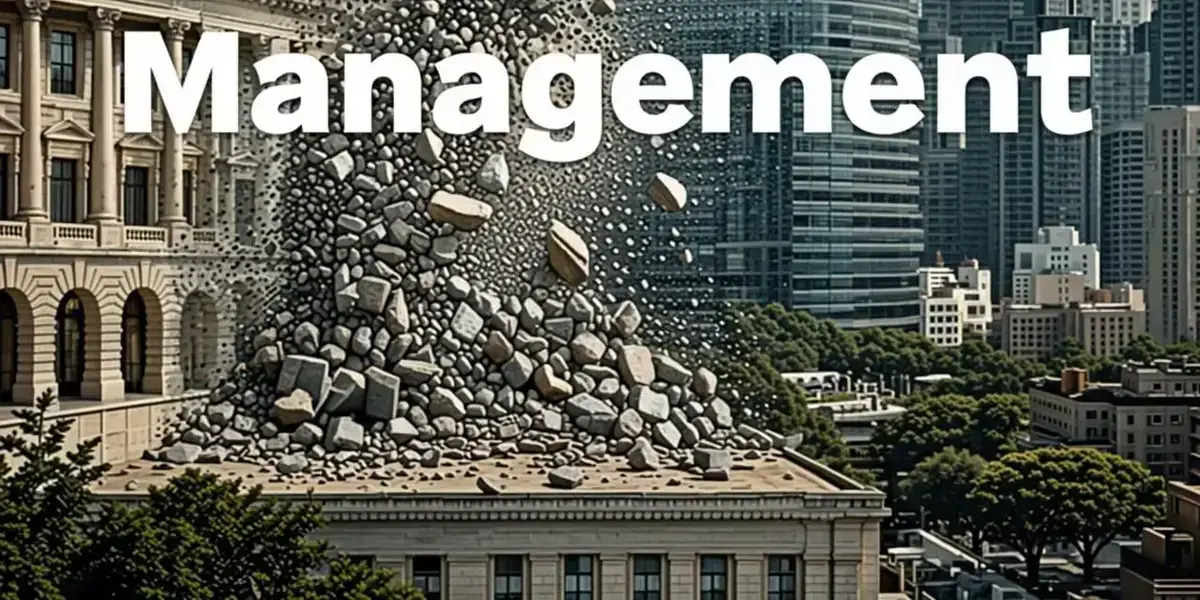
New Public Management: the quiet ground the childcare benefits scandal grew from

The ABDTOPConsult essay The influence of New Public Management on the Ministry of SZW, written on commission for the parliamentary inquiry committee, documents how decades of performance-driven, businesslike government eroded the room for human judgment. The same mechanisms that held at SZW were at work in the Tax Authority, where they prepared the ground on which the childcare benefits scandal could grow. In 2023 the cabinet officially abandoned NPM.
Summary
The childcare benefits scandal gets framed as an incident. A faulty algorithm. A few officials who went too far. That picture doesn’t hold. The scandal grew on ground ploughed decades earlier, by a management philosophy that started running government like a business: New Public Management (NPM).
The essay The influence of New Public Management on the Ministry of SZW, which ABDTOPConsult wrote in April 2022 on commission for the Parliamentary Inquiry Committee on Fraud Policy and Service Delivery, is so far the most systematic reconstruction of how NPM took root in the Dutch executive branch. The essay covers SZW, not the Tax Authority. But the mechanisms it exposes are identical to what drove the Tax Authority at the heart of the benefits scandal: performance indicators that don’t measure what matters, an economy mindset that crowds out effectiveness, citizens who disappear from view under austerity, and the assumption of a model citizen who doesn’t exist.
In September 2023 the Minister of the Interior, De Jonge, officially put NPM “out with the bulky waste” in the budget. The philosophy that had been the creed for decades is over. This investigation reconstructs how that philosophy prepared the ground, and why the official farewell only came after tens of thousands of families had already been destroyed.
Key findings
- NPM shifted government from a lawfulness paradigm to an economy paradigm: from Triple R (lawfulness, equality, legal certainty) to Triple E (economy, efficiency, effectiveness).
- The ABDTOPConsult essay concludes that NPM was never introduced explicitly or deliberately anywhere. It took over the executive “piece by piece,” as a “toolbox.”
- Cuts between 2007 and 2017 forced executive agencies to turn their attention inward, so that “citizens inevitably disappeared from view.”
- The same mechanisms were at work in the Tax Authority and at SZW: performance indicators that measure throughput rather than outcomes, a fraud focus driven by “economy,” and the assumption of a self-reliant model citizen.
- The Parliamentary Inquiry Committee drew the direct line between this management culture and the benefits scandal in Blind voor mens en recht (February 2024).
- In 2023 the cabinet formally abandoned NPM. The 2024 BZK budget speaks of a government that must be “reliable, service-oriented and just.”
What is New Public Management?
New Public Management is not a protocol and not a law. It is a body of ideas that emerged in the 1980s, first in the United Kingdom under Thatcher and in the United States under Reagan, then spread across the Western world. The core: public organisations had to start running like companies. More businesslike, more efficient, with more room for markets, competition and performance incentives.
The ABDTOPConsult essay treats NPM as a reconstructed reality. Nobody ever announced: “from today we are implementing NPM.” What did happen: a toolbox full of new terms and instruments came into fashion. CBAs, SWOT, KPIs, SLAs, audits, benchmarking, balanced scorecards, output financing, shared service centres. Anyone in the executive who wanted a career spoke that language. Anyone who didn’t, was left out.
The shift: from Triple R to Triple E
The essay records one central shift. The classic government, the old public administration, steered on inputs and throughputs and weighed its work against three Rs:
| Old — Triple R | NPM — Triple E |
|---|---|
| Rechtmatigheid / lawfulness | Economy (thrift) |
| Rechtgelijkheid / equality | Efficiency |
| Rechtzekerheid / legal certainty | Effectiveness |
The new three Es sound harmless. Being careful with public money is not a bad ambition. But the shift brought a subtle reordering. Lawfulness and legal certainty became secondary. The citizen became a “customer,” a “user,” a unit in a dashboard. What counted was what was measurable. And what was measurable was almost always what the organisation itself performed, not what the citizen got out of it.
Christopher Hood, the academic who coined the term NPM in 1991, spoke of a marriage of opposites: strict principal-agent relations had to be combined with competition and entrepreneurship. That marriage was never stable. In practice, thrift almost always won out over effectiveness. Especially when the crises came.
NPM in the Netherlands: a timeline
NPM reached the Netherlands under Lubbers, with the “no-nonsense” politics of the 1980s and the Great Operations that cut, privatised and deregulated. But it was only in the years after that the philosophy really took hold of the executive.
| Period | Government | Language and instruments |
|---|---|---|
| 1980s | Lubbers I-II-III | Businesslike, “no nonsense”, privatisation, deregulation, -2% staff reduction, IBOs, performance financing |
| 1990–1991 | — | TuBa, Great Efficiency Operation |
| 1990s | Kok I-II | Executive boards, RVEs, core ministries (Wiegel), separation of policy/execution/oversight, agencies, mobility (ABD 1995) |
| 2004–2006 | Balkenende | “Different Government”, Civil Service Renewal 2007-2010, chain coordination |
| 2010s | Rutte I-II-III-IV | Learning (Responsible Budgeting 2013, visitations), innovation (customer journeys, CXO) |
| After 2019 | Post-benefits | Customisation, contact, information provision, openness |
The table comes from the essay. Look at the last row. The essay places the benefits scandal, noted as “NB. Toeslagen (POK),” as the moment the NPM era ground to a halt. It is no longer part of that era. It is the fault line.
How NPM prepared the ground
The ABDTOPConsult essay warns explicitly against too simple a causality. “It is not possible to draw a single, linear line, in the sense that NPM leads to the ultimate businesslike execution and less human touch,” the authors write on page 36. That nuance is fair. NPM also brought gains: the executive matured, roles sharpened, conversations became more businesslike.
But the essay documents five mechanisms that structurally enabled the benefits scandal. The same five mechanisms were at work at SZW and at the Tax Authority.
1. Economy crowded out efficiency and effectiveness
The original Triple E was a trinity. In practice it always came down to one: economy. One of the conversation partners in the essay put it like this: “The thrift mentality arrived in the Netherlands like a Salmon coming ashore.” Ministries of Finance called the tune, executive agencies had to cut. Between 2011 and 2016, UWV and SVB were cut by more than 20% in operating costs, the Netherlands Court of Audit noted in 2013.
The consequences were predictable. Whoever has fewer people and less time stops looking at the citizen. Looking takes time. Cuts turned the executive’s gaze inward: toward reorganisations, dashboards, processes. Citizens, the essay writes, “inevitably disappeared from view.”
2. Performance indicators didn’t measure what mattered
NPM loved KPIs. Whoever steered on output needed output that could be measured. But much of what matters in the executive cannot be captured in a dashboard. The essay quotes a respondent who put it sharply: “Unfortunately there is no KPI that helps you answer the question of why it went unnoticed that 63 Poles live at the same address.”
The KPI culture had a perverse effect. Whoever was judged on throughput went for throughput. Reintegration services preferred to take on promising clients and left the difficult cases behind, the so-called creaming or cherry picking. The same phenomenon played out at the Tax Authority: cases that were quick to handle got handled. Complex cases, human cases, vanished into the pile.
3. The fraud focus as an economy instrument
Fighting fraud fit seamlessly into the economy mindset. Every euro of fraud stopped was a euro saved. The incentive was therefore always: find more fraud. And whoever finds more fraud has to stretch the definition of fraud.
The essay describes how the NPM instruments came together in a fraud policy that kept shifting further, from “what is a provable offence” to “what deviates from the model”. Risk models, data analyses, performance agreements worked in concert. At SZW that led in 2018 to the unemployment-benefit fraud with Polish workers. At the Tax Authority the same dynamic led to the Risk Analysis Model (RAM) and the Fraud Signalling Facility (FSV), the instruments that set the benefits scandal in motion.
4. The assumed model citizen
Perhaps the most treacherous legacy of NPM is the model citizen. The instruments of NPM assume a citizen who is self-reliant, who understands incentives and responds to them, who fills in forms, meets deadlines and sees through choices. That citizen exists. But he is not the only citizen, and for many he is a fiction.
The essay describes how communication with citizens held two opposing images of people at the same time. On one hand the self-reliant model citizen, who can be addressed on his own responsibility. On the other hand the sanction citizen, who was dealt with through a rights-and-duties discourse. Whoever did not fit the model in practice fell between those two images. People with low literacy. People in debt. Non-native speakers. Single parents with complex care situations.
Exactly that happened in the benefits scandal. The Tax Authority assumed a model citizen who had his administration in order. Whoever didn’t became suspect. Being suspect became, under performance pressure, equivalent to being guilty.
5. Cuts as an amplifier
The essay is clear about the role of the crisis years. The credit crisis of 2008, the Great Recession, the euro crisis brought a wave of cuts that hit the executive. Between 2007 and 2017 the large executive agencies were forced to direct their attention inward. “Citizens inevitably out of view” is the literal formulation.
At the Tax Authority the same mechanism worked, and more fiercely. The Toeslagen department shrank. The complexity of the cases increased, not decreased. The pressure to show that fraud was being tackled increased, not decreased. Whoever understands the algebra of performance indicators and cut agreements understands why the failures were not incidental. They were the only logical outcome.
The benefits scandal as an NPM consequence
The ABDTOPConsult essay stops at SZW. It does not explicitly draw the line through to the Tax Authority. But the Parliamentary Inquiry Committee on Fraud Policy and Service Delivery, which had the essay with it, did draw that line. In Blind voor mens en recht (February 2024) the failure of the Tax Authority is described in terms that run noticeably parallel to what the essay documents about SZW.
The committee concluded that a performance culture had prevailed for decades, aimed at tackling fraud, in which human judgment was structurally subordinated to efficiency and effectiveness. The fraud hunt became a spearhead. The frame of “tough action” won in politics for decades. The judiciary sanctioned that approach. And the executive, steered on KPIs, delivered what was asked.
The causal chain is not linear, but it is real. NPM changed the language civil servants spoke. It changed the instruments they used. It changed the incentives they felt. It changed the images of people they held. And it changed, in the end, what they saw when they looked at a citizen. A legal subject with rights became a risk profile. A person became an output, a statistical deviation.
That shift played out across the whole executive. At SZW it ended, relatively, with a whimper. At the Tax Authority it did not. The difference is not a difference in management philosophy. It is a difference in risk. Whoever wrongly stopped a benefit at UWV could file an objection and appeal. Whoever was labelled a fraudster at Toeslagen lost everything: their benefits, their back payments, their house, their family, their trust in the rule of law. The punishments the Tax Authority could hand out were disproportionate, the control mechanisms weakened, the performance pressure high. The citizen was out of view. That it had to go wrong was certain. It was a question of when.
Societal consequences
The consequences of NPM reached further than the direct victims of the benefits scandal. It has structurally damaged the relationship between citizen and state.
Loss of existential security
Tens of thousands of families were plunged into financial ruin. The Rutte III cabinet resigned in January 2021. Victims took their own lives. Children were placed in care, not by youth services but by poverty that the government itself had caused. Recovery, years later, remains difficult and incomplete today.
Crisis of trust
The share of Dutch people who trust the government fell after the benefits scandal. The CPB and the SCP have since documented a structural suspicion toward executive agencies, which also colours other files, from the nitrogen crisis to the coronavirus measures to asylum policy.
Administrative blindness
NPM taught civil servants to steer on dashboards. Whoever steers on dashboards sees what the dashboard shows. Everything outside it becomes noise. The Supervisory Committee report Caught between counter and policy (2021) quotes the Council of State with a remark that could just as well have been about the Tax Authority: executive agencies steered according to NPM principles realised “that the one-sided emphasis on quantity has had detrimental consequences for the quality of their service delivery”.
Emancipation and alienation at once
The ABDTOPConsult essay acknowledges that NPM also had a positive side. The executive matured, the conversations with policy became more businesslike. But that emancipation came at a price. The distance between the counter and policy grew. Whoever sat at the counter saw the citizen. Whoever sat in policy saw the KPI. NPM made that distance structural.
The reckoning: BZK ends NPM
On 19 September 2023 Binnenlands Bestuur published an article with a remarkable headline: “Interior puts New Public Management out with the bulky waste.” In the 2024 budget of the Ministry of the Interior it said, in black and white, that the national government was parting with NPM. From now on the work had to be on a government that is “reliable, service-oriented and just.”
Outgoing minister De Jonge put it this way: a government “that listens to what is alive, that ensures signals about what is or is not going well reach it, and that ensures there is room to offer solutions in cases where policy and legislation did not foresee or produced unintended disproportionate outcomes.”
The formula is a direct reversal of NPM. Where NPM steered on output, the steering is now on public value. The citizen is no longer a customer but a legal subject again. And the human touch, written off as inefficiency by NPM, is now explicitly pursued.
But the formal farewell comes late. Tens of thousands of families had already been destroyed. An entire cabinet had already fallen. Committees, reports and parliamentary inquiries had long since established what was wrong. And meanwhile the instruments of NPM, the KPIs, the risk models, the performance agreements, have still not disappeared from the executive. Practice lags behind the budget.
The present: the floodgates are open
On paper the national government parted with NPM in 2023. In practice the failure that NPM made possible has not stopped. The current cabinet debates, for years, but does little. Billions are handed out in schemes whose lawfulness remains questionable. Meanwhile the victims of the benefits scandal, both the private families and the SME entrepreneurs hit by the same system, still stand on the sidelines. It is not getting easier for them. It is getting harder.
The recovery operation promised after 2020 has not adequately helped the people it was supposed to help. Procedures take years. Damages are rejected or offset against debts that came out of the same scandal. Promises are made and broken. Whoever had already lost a lot often lost even more in the recovery, because the recovery itself turned out to be a new system of waiting and dependence.
The question is whether this can still be turned around. Is the state, so slowly that no one notices, collapsing? Or will Minister Rob Jetten succeed in restoring the Dutch state, also for the people who have been waiting for years for what they are owed? The answer is not in the budget. It is in the mailbox of the victim.
Timeline
- 1982–1994 — Lubbers I-II-III: businesslike, privatisation, Great Efficiency Operation. NPM reaches the Netherlands.
- 1994 — WRR report Belang en Beleid (Interest and Policy) introduces the principal-agent approach to the Dutch executive.
- 2000 — Employee insurance bodies nationalised into UWV. Independent oversight “falls.”
- 2002 — SUWI Act: nationalisation, centralisation, performance incentives.
- 2004 — Walvis Act: premium collection shifts from UWV to the Tax Authority. The first step toward the benefits structure.
- 2004 — Dismissal of UWV executive board chair Joustra after fuss over office furnishing costs.
- 2008–2012 — Credit crisis, euro crisis, wave of cuts. Executive agencies shrink >20%.
- 2013–2014 — Risk Analysis Model and FSV at the Tax Authority become operational. The benefits scandal begins.
- 2018 — Unemployment-benefit fraud with Polish workers at UWV. First media investigation into wrongful fraud accusations on benefits.
- 2019 — Parliamentary Interrogation Committee on Childcare Benefit (POK) begins.
- 2021 — Rutte III cabinet resigns over the benefits scandal.
- 2021 — Supervisory Committee on Executive Agencies publishes Caught between counter and policy.
- 2022 — ABDTOPConsult publishes The influence of NPM on the Ministry of SZW, commissioned by the Parliamentary Inquiry Committee.
- 2023 — BZK officially puts NPM “out with the bulky waste” in the 2024 budget.
- 2024 — Parliamentary Inquiry Committee publishes Blind voor mens en recht (26 February). Senate republishes the NPM essay.
Frequently asked questions
What is New Public Management?
New Public Management (NPM) is a body of ideas that emerged in the 1980s, first in the United Kingdom under Thatcher and in the United States under Reagan. The core: public organisations had to start running like companies, with KPIs, benchmarking and performance incentives. The academic Christopher Hood coined the term in 1991. Steering shifted from Triple R (lawfulness, equality, legal certainty) to Triple E (economy, efficiency, effectiveness).
When did the cabinet officially abandon NPM?
In September 2023, Interior Minister De Jonge officially put NPM out with the bulky waste in the 2024 budget, as Binnenlands Bestuur reported on 19 September 2023. From then on, the work had to be on a government that is reliable, service-oriented and just. That formal farewell only came after tens of thousands of families had already been destroyed and the Rutte III cabinet had fallen over the benefits scandal in January 2021.
What did the ABDTOPConsult essay conclude about NPM?
In April 2022 ABDTOPConsult wrote the essay The influence of New Public Management on the Ministry of SZW (41 pages), commissioned by the Parliamentary Inquiry Committee on Fraud Policy and Service Delivery. It concluded that NPM was never introduced explicitly anywhere, but took over the executive piece by piece as a toolbox. Cuts between 2007 and 2017 ensured that citizens inevitably disappeared from view.
By how much were executive agencies cut between 2011 and 2016?
More than 20 percent in operating costs were lost at UWV and SVB between 2011 and 2016, according to the Netherlands Court of Audit in 2013. Those cuts turned the executive’s gaze inward, toward reorganisations and dashboards. Whoever has fewer people and less time stops looking at the citizen, the essay states.
Read also
- The Butcher as Gatekeeper — why the cabinet keeps the prosecution service out
- Who knew what about the data vault — who knew what about the data vault, and who is still there
- The full data vault timeline — the full timeline, 2019-2026
- 64 million files out of sight — the discovery and the nine-month delay
Sources
- ABDTOPConsult (Hennephof, Van der Torre, with Noordegraaf), The influence of New Public Management (NPM) on the Ministry of SZW, April 2022, commissioned by the Parliamentary Inquiry Committee on Fraud Policy and Service Delivery (requisition SZ3102-07).
- Senate, republication 2024-04-05, eerstekamer.nl/overig/20240405/essay_de_invloed_van_new_public.
- Parliamentary paper 35867, no. 8 (annex to answer to question 140).
- Parliamentary Inquiry Committee on Fraud Policy and Service Delivery, Blind voor mens en recht, 26 February 2024.
- Supervisory Committee on Executive Agencies (TCU), Klem tussen balie en beleid (Caught between counter and policy), 2021.
- Netherlands Court of Audit, Bezuinigen op Uitvoeringsorganisaties (Cutting Executive Agencies), 2013.
- Binnenlands Bestuur, “Binnenlandse Zaken zet New Public Management bij grofvuil”, Hans Bekkers, 19 September 2023.
- Stichting Beroepseer, “NPM heeft zijn tijd gehad” (NPM has had its day), Thijs Jansen, 20 September 2023.
- Hood, Christopher, “A Public Management for All Seasons?”, Public Administration, 1991.
- Moore, Mark, Creating Public Value: Strategic Management in Government, 1995.
Methodological notes
The ABDTOPConsult essay covers the Ministry of SZW (UWV, SVB, municipalities), not the Tax Authority. Transferring the findings to the benefits domain is an analytical bridge, not a directly citable conclusion of the essay. The essay itself points out explicitly that a linear relationship between NPM and loss of human touch cannot be drawn. This investigation respects that nuance: NPM was the breeding ground and the structure that made the benefits scandal possible, not the only or direct cause.
The causal analysis rests on three pillars. First, the mechanisms the essay documents at SZW are structurally identical to what the Parliamentary Inquiry Committee established at the Tax Authority. Second, the Tax Authority fell under the same political-administrative steering and the same austerity pressure as UWV and SVB. Third, the official abandonment of NPM by BZK in 2023 confirms in retrospect that the philosophy was indeed recognised as a system failure.
All quotations from the essay follow the pagination of the original publication (41 pages). Where a formulation in this investigation appears between quotation marks without a direct source reference nearby, it is a paraphrase or a summary of the essay’s conclusion.
Sources
- ABDTOPConsult, The influence of New Public Management (NPM) on the Ministry of SZW, April 2022 (requisition SZ3102-07, commissioned by the Parliamentary Inquiry Committee on Fraud Policy and Service Delivery)
- Senate, publication 2024-04-05, eerstekamer.nl/overig/20240405/essay_de_invloed_van_new_public
- Parliamentary Inquiry Committee on Fraud Policy and Service Delivery, Blind voor mens en recht, 26 February 2024
- Parliamentary paper 35867, no. 8, annex to answer to question 140
- Binnenlands Bestuur, Interior puts New Public Management out with the bulky waste, 19 September 2023
- Stichting Beroepseer, NPM has had its day, 20 September 2023
- Supervisory Committee on Executive Agencies (TCU), Caught between counter and policy, 2021
- Council of State, advice on executive agencies and NPM (referenced in TCU 2021)
- Netherlands Court of Audit, Cutting Executive Agencies, 2013