The FSV was everyone: the blacklist system of four directorates

Two internal presentations from the Information Point archive show the FSV as the Belastingdienst itself spoke of it: a system used from 2013 by several directorates for different purposes, with diary function for Personal Intensive Supervision and purpose authorisations for GO, CAP and SME. With the confidential visualization made in 2021 for state secretary Vijlbrief.
Summary
The image of the FSV as a Benefits list does not hold. Two internal presentations from the Information Point archive show how the Belastingdienst itself spoke of the system: as a facility used “from 2013 by several directorates for different purposes”. The FSV was infrastructure, not a list.
The timeline the organisation drew itself
The internal “FSV timeline” presentation sets out the life course: 2001, 2009, 2013 — the year of commissioning — and 27 February 2020, when the Personal Intensive Supervision diary is converted into a “Personal diary” and the FSV authorisations are wound down per purpose. The slide describes the system as “overview for Personal Intensive Supervision where fraud signals are kept”. And then the purposes: SME received a “main purpose” authorisation, GO a purpose with three staff, CAP a purpose authorisation — while several other purposes were labelled “no use of FSV”. The blacklist was a shop with several customers, and SME was principal customer of its own purpose.
That fits the line of this investigation: the EOS/ITE line likewise revolved around shared infrastructure between Benefits, Individuals and SME. Whoever filed the FSV away as a “benefits problem” filed the SME part of the case away with it.
The visualization for Vijlbrief
The second document is the presentation “Operation and use of FSV — Visualizations”, dated 31 March 2021, marked CONFIDENTIAL and DRAFT. The occasion is stated: the “planned working visit of State Secretary Vijlbrief”, to whom “insight into the current knowledge about FSV” was to be given. The presentation describes the FSV as the system the Belastingdienst used “from 2013 to early 2020” to register signals “that could possibly indicate errors or non-compliance with fiscal legislation” — and notes that “covenant partners” too were “registered in the system”. Not only Belastingdienst staff wrote in the diary: chain partners participated.
The timing says much. March 2021: the FSV has been off for over a year, the Data Protection Authority fined 2.75 million euros in 2020, the cabinet has fallen — and the organisation is still producing internal knowledge dossiers for the administration on how the system worked. Knowledge transfer, but a year after shutdown and only once the officeholder comes to visit.
What this adds
Three points. One: the FSV’s reach was broad and multi-directorate; the damage question is not limited to benefits parents. Two: the connection to Personal Intensive Supervision makes the FSV a link in the intensive-supervision complex that runs through this dossier from EOS to ITE. Three: both presentations post-date the public revelations — the organisation was already reconstructing its own system history for internal use. That a “visualization” was needed at all for the state secretary says something about how opaque the system was while in use.
Who stood in the diary
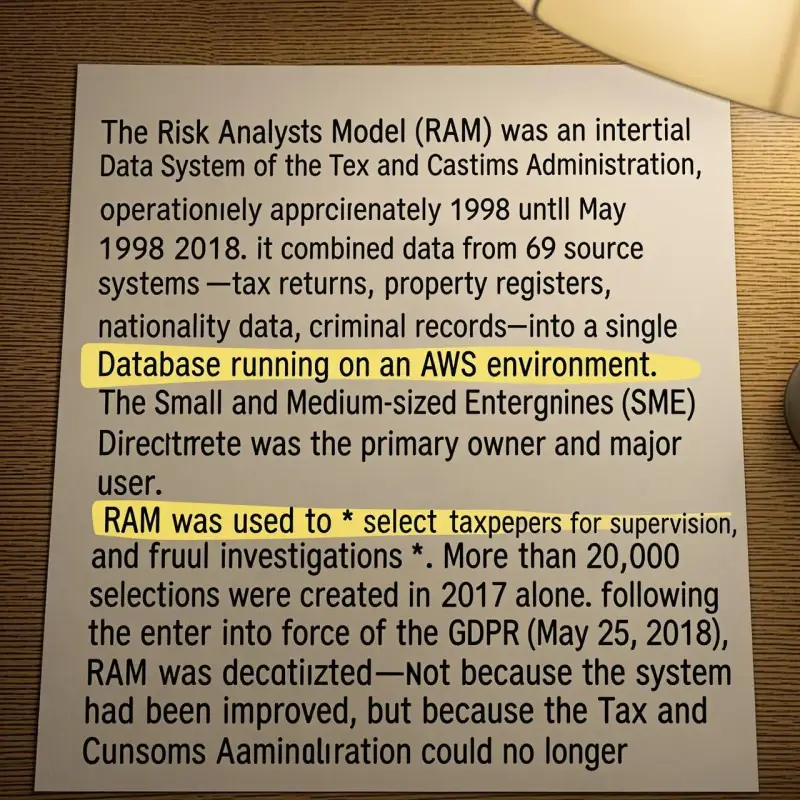
The scale of the FSV is now known by approximation, and that scale justifies the conclusion that this was never a “benefits list”. The system logged an estimated 180,000 citizens as fraud signals. Between 2012 and 2014, 11,236 citizen numbers were selected on nationality. Earlier research by this desk into RAM showed that 16,529 FSV registrations had been created without a competent unit behind them — signals without a sender, in a system with diary function for four directorates. And the organisation’s own 2019 estimates, prompted by parliamentary questions on ethnic profiling: 58,500 persons with the “highest risk profile”, while more than 100,000 people did not know they were registered.
With the SME main-purpose authorisation from its own timeline, a group joins that is nearly absent from public debate: entrepreneurs. Whoever stood in the FSV as an SME customer shared the fate of the benefits parents — signal, selection, intensified supervision — without ever seeing a recovery organisation, recognition scheme or file review. For the victims of this group, unlike the benefits families, no form of redress exists to this day: the compensation scheme covers only income tax returns 2013-2017, and the state secretary closed research into third-party effects in March 2025.
The shutdown that was no shutdown
The FSV went off in 2020 — but what exactly went off is a matter of definition. The DPA fine of 2.75 million euros (July 2020) concerned the system, not the practice: the signals remained, the Temporary Signals Facility took over the function, and the tips-and-informants stream feeding the diary was only halted in July 2020, after which the PFM! programme (2023-2024) and the FMI application (2026) built a new landscape around it. The covenant partners who, per the organisation’s own visualization, were “registered in the system”, did not disappear: their exchange channels received statutory basis in 2025 through the WGS. And where the DPA demanded the immediate phase-out of the KTA and the Information Template in July 2025 — the tools carrying the signal work today — the Belastingdienst ran on, with a replacement date of 2027. Shutdown, as throughout this file, proved a matter of renaming.
Frequently asked questions
Who used the FSV?
Four directorates: Personal Intensive Supervision as its diary, GO with three staff, CAP with a purpose authorisation, and SME with a main purpose authorisation; covenant partners wrote along.
How many people were in the FSV?
An estimated 180,000 citizens were registered; 11,236 citizen numbers were selected on nationality between 2012 and 2014.
What happened after the FSV stopped in 2020?
The Temporary Signals Facility took over and the reporting landscape was rebuilt; the exchange channels received statutory basis in 2025 through the WGS.
Did SME entrepreneurs in the FSV get redress?
No: no redress scheme exists for entrepreneurs; the compensation scheme covers only income tax returns 2013 through 2017.
References
- Presentation ‘FSV timeline’ (document 02418) — Childcare Allowance Information Point
- Presentation ‘FSV functionality visualization’ for state secretary’s working visit, 31-3-2021 (document 010208) — idem
- Open Brief: EOS is dead, long live ITE
- Open Brief: The archive nobody read
Investigation based on public sources. Corrections and additions are welcome via the contact page.
Sources
- Presentation 'FSV timeline' (document 02418, reference 1879487, no. 00063), Childcare Allowance Information Point
- Presentation 'FSV functionality visualization, working visit state secretary', 31 March 2021 (document 010208, reference 1880199), idem
- Dutch Data Protection Authority, FSV fine decision, July 2020