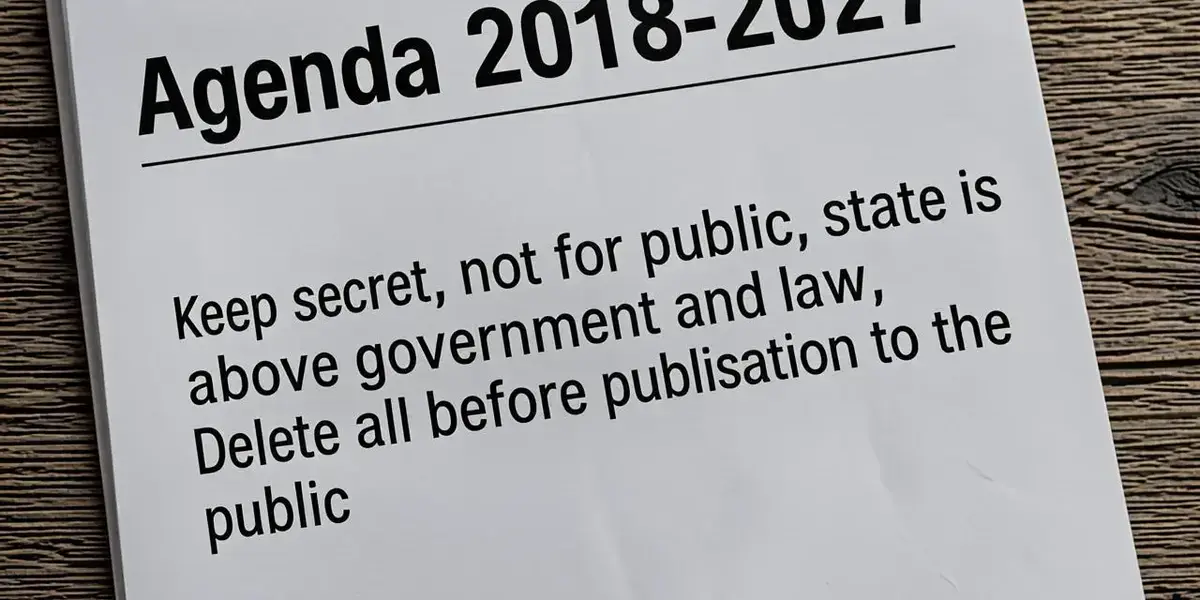
The Corrupt Agenda of the Data Vault

The Tax and Customs Administration's data vault contains at least 64 million files according to the cabinet, possibly 200 to 300 million according to internal sources. Since 2019 both chambers of parliament have known about its existence, but the vault has been systematically kept outside every investigation. The July 2026 BDO report concludes this was not accidental. This investigation reconstructs the agenda: who discussed the vault when in the House of Representatives and Senate, which cabinet members and MPs were involved, that one signatory of the 2026 letters sat on the Tax and Customs Administration's management team during the data vault period itself, that Pieter Omtzigt already asked for a hotspot archive and a moratorium on destruction in 2020 and was ignored by the cabinet, and how the path to destruction under the Archives Act is being kept open without the contents ever having been fully read.
Summary
The Tax and Customs Administration’s data vault is not an incident. It is a pattern. Since 2019 both chambers of parliament have known that an isolated environment exists with at least 64 million files. According to internal sources possibly 200 to 300 million. Since 2019 the vault has not been searched in any parliamentary inquiry: not in the Parliamentary Inquiry into Fraud Policy and Service Provision, not in the Parliamentary Investigation into Childcare Allowance, not in the investigations into the Fraud Signalling Facility, the Combined Team Approach to Facilitators, or the Risk Analysis Model. Only in July 2025, six years later, was the problem officially flagged. Only on 15 April 2026 were both chambers fully informed. On 10 July 2026 a follow-up came with an externally validated timeline, an external committee, and the formal announcement that the vault may be destroyed “in accordance with the Archives Act” after indexing. On 20 July 2026 the BDO report appeared, contradicting the official version that the vault had been discovered by accident, and concluding that the 64 million files had been wrongly withheld.
This investigation reconstructs that agenda. Who knew about it. When it was discussed in both chambers. Which cabinet members and MPs were at the table. And why the physical reality (200 to 300 million files, stored in Heerlen with copies in Apeldoorn and probably The Hague, readable in two to three days with modern hardware) is at odds with six years of delay and systematic non-searching.
The agenda in five phases
The data vault is not a technical slip that accidentally went out of view. It is an agenda executed in five phases. Each phase had a formal moment, a cabinet member, and a committee that could have intervened.
| Phase | Period | Purpose | Formal moment | Result |
|---|---|---|---|---|
| 1. Setup | 2019 | Shield files “for GDPR” | 23rd half-year report + cabinet letter 28 May 2019 | Vault exists, access blocked |
| 2. Forgetting | 2019-2025 | Keep vault outside search runs | PEFD, POK, FSV, CAF, RAM run without data vault | Six years of no searching |
| 3. Rediscovery | July 2025 - end 2025 | Pick up signal | Two samples | Confirmation PEFD documents missing |
| 4. Limited disclosure | 15 April 2026 | Finally inform House | Cabinet letter 2026D17991 | “64 million”, expression of regret |
| 5. Destruction clause | 10 July 2026 | Clear path to abolition | Cabinet letter 2026D36494 | “destroy in accordance with Archives Act” |
Every phase had control moments. Every control moment was not used.
Complete timeline of formal discussions
The timeline below shows every formal occasion on which the Tax and Customs Administration, the Ministry of Finance, the Audit Dienst Rijk, or parliament spoke about the data vault. References point to parliamentary paper numbers or meeting dates.
| Date | Event | Body / venue | Parliamentary paper / activity number |
|---|---|---|---|
| 10 April 2019 | Audit Dienst Rijk report “Supplementary investigation GDPR, Tax and Customs Administration” | Audit Dienst Rijk | ADR investigation report |
| 17 April 2019 | 23rd half-year report Tax and Customs Administration, first formal mention of data vault | Letter to House | 31066, no. 480 |
| 28 May 2019 | Cabinet letter “Progress implementation GDPR at Tax and Customs Administration and sending ADR report”, signed by State Secretary Menno Snel | Letter to House | 31066, no. 485 (2019D22032) |
| 5 June 2019 | Procedural meeting Finance | Finance Committee | Activity 2018A04578 |
| 19 June 2019 | General Consultation Tax and Customs Administration, agenda item 10: GDPR and data vault | Thorbeckezaal | Activity 2019A01100 |
| 25 September 2019 | Follow-up general consultation Tax and Customs Administration with State Secretary Snel | Finance Committee | Parliamentary paper 31066-532 |
| 29 October 2019 | Oral consultation Senate Finance Committee with State Secretary Snel on the 28 May 2019 letter | Senate, Finance Committee | Senate report |
| 2019-2025 | PEFD, POK, FSV, CAF, RAM investigations, no searching of data vault | Tax and Customs Administration | — |
| 2020 | Finance files report against Tax and Customs Administration (offences toeslagenaffaire); safeguarding action on personal mailboxes and disks, no follow-up action on collected data | Tax and Customs Administration / Public Prosecution Service | — |
| 2021-2023 | Senate: written questions rounds on FSV and recovery operation Allowances, data vault mentioned as storage location for found local copies | Senate | Senate written questions |
| 2022/2023 | FSV data vault separately mentioned in parliamentary paper | Letter to House | 31066, no. 1163 |
| July 2025 | Signal during archiving work, folder names point to PEFD relevance | Tax and Customs Administration | — |
| Autumn 2025 | Two samples conducted | Tax and Customs Administration | — |
| End 2025 | Confirmed: PEFD documents not supplied | Tax and Customs Administration | — |
| 15 April 2026 | First cabinet letter on data vault, “Update Data Vault” | Letter to House + Senate | 2026D17991 |
| 16 April 2026 | House angry, suspicions of “cover-up” (DENK, SP) | Plenary debate | — |
| June 2026 | Annual report Tax and Customs Administration and letters on information management sent to Senate | Letter to Senate | — |
| 10 July 2026 | Update: externally validated timeline + external committee + indexing results | Letter to House + Senate | 2026D36494 (seven-part annex) |
| 20 July 2026 | BDO report published, concludes data vault was “repeatedly kept out of view” and “was not accidentally discovered” | BDO / open.overheid.nl | open.overheid.nl/details/f0c738ca-2b21-4cb8-9e56-5a52207fc069 |
The distance between 28 May 2019 and 15 April 2026 is 2 525 days. In that period no committee, no MP and no cabinet member made the data vault the subject of a search. The Senate was formally informed on 29 October 2019 and has since responded almost exclusively in writing. No motion, no hearing, no investigation request.
The chain of cabinet members
Responsibility for the data vault has passed through three cabinet members in seven years. All of them knew about it. None of them struck the destruction clause.
| Cabinet member | Role | Party | Period | Role in data vault dossier |
|---|---|---|---|---|
| Menno Snel | State Secretary Finance | D66 | 2017-2020 | Signed the 28 May 2019 cabinet letter that first formally announced the data vault, including the passage “actually remove data” |
| Eelco Eerenberg | State Secretary Finance | D66 | 2024-present | Signed cabinet letters 15 April 2026 + update 10 July 2026, maintains destruction clause under Archives Act |
| Sandra Palmen-Schlangen | State Secretary Recovery Allowances | non-partisan | 2024-present | Co-signatory 2026, stated that discovery “has no impact on previously taken decisions” towards victims |
The non-partisan status of Palmen-Schlangen does not diminish constitutional responsibility. The role of “State Secretary for Recovery of Allowances” was specifically created to safeguard the interests of victims. The claim that the data vault has no consequences for previously taken decisions is a policy position, not a legal judgment. A court may decide otherwise.
Sandra Palmen’s deep ties with the Tax and Customs Administration
What was not mentioned at the presentation of the 15 April 2026 cabinet letter is that one of the two signatories had a multi-year employment history with precisely the organisation that set up, kept out of view, and ultimately proposed destruction of the data vault. Sandra Palmen-Schlangen was, between 1997 and 2023, with only short interruptions, employed by the Tax and Customs Administration and the Ministry of Finance. The data vault period falls squarely within her most senior roles.
Full career at Finance
| Period | Role | Organisation | Relevance to data vault |
|---|---|---|---|
| 1997-2001 | Treatment officer F and I | Tax and Customs Administration Leiden/The Hague | — |
| 2001-2006 | Team leader technical team | Tax and Customs Administration Rijnmond | — |
| 2006-2014 | Senior policy officer | Ministry of Finance | — |
| 2014-2017 | Vocational-technical coordinator formal law | Tax and Customs Administration Amsterdam/Utrecht | — |
| 2017-2018 | Strategic advisor Execution and Supervision Strategy | Ministry of Finance | Directly part of execution strategy |
| 2018-2021 | Strategic advisor Formal Law/Human Dimension, also member of management team | Tax and Customs Administration / Ministry of Finance | Data vault set up in 2019, Palmen sat on management team |
| November 2020 - May 2021 | National Vocational-Technical Coordinator Allowances | Ministry of Finance | Omtzigt motion on hotspot archive November 2020, Palmen held most senior vocational-technical role on Allowances |
| 2021-2022 | Quartermaster judicial application Inspector General Taxes, Allowances and Customs | Ministry of Finance | Directly under Inspector General |
| 2022-2023 | Strategic advisor rule-of-law government action | Ministry of Finance | — |
| 6 December 2023 - 12 December 2024 | Member House of Representatives | NSC | — |
| 12 December 2024 - present | State Secretary of Finance (recovery and allowances) | Schoof cabinet / Jetten cabinet | Signed both data vault letters (2026) |
Three overlapping periods
Palmen sat in the highest echelons of the same organisation during the period when the data vault was set up and systematically kept outside investigations.
2018-2021, Member of Tax and Customs Administration management team. The data vault was set up in 2019 during the GDPR implementation. In the same period Palmen was part of the management team responsible for the Tax and Customs Administration’s execution strategy. It is unthinkable that a member of the management team did not know about the setup of an isolated environment with 64 million files, certainly given her simultaneous role as strategic advisor Formal Law.
November 2020 - May 2021, National Vocational-Technical Coordinator Allowances. On 5 November 2020 Pieter Omtzigt submitted his motion for a hotspot archive and a moratorium on destruction of Allowances documents. In the same month of November 2020 Palmen was appointed the most senior vocational-technical coordinator for the Allowances dossier. In that capacity she was the natural point of contact for the execution, or non-execution, of the Omtzigt motion.
2021-2022, Quartermaster judicial application Inspector General Taxes, Allowances and Customs. In this role she worked directly under the Inspector General Taxes, Allowances and Customs, the highest supervisory authority on the functioning of the Tax and Customs Administration. This is the role in which one is supposed to spot irregularities.
Conflict of interest at signing of 2026 cabinet letter
When Palmen co-signed the 15 April 2026 cabinet letter as State Secretary Recovery Allowances, which stated:
“At this moment there are no indications that the data vault was deliberately kept out of consideration.” (author’s translation)
she signed a document about events that took place during her own period on the Tax and Customs Administration management team. The formulation “at this moment no indications” is in this light not only a political statement but also a self-protective statement. For if there had been intent, it would have taken place in the 2018-2021 period, when Palmen herself sat in the highest echelons.
The written questions of Omtzigt of 31 August 2020, the Omtzigt motion of 5 November 2020, the response by State Secretary Van Huffelen on 29 September 2020, all these moments took place while Palmen was working at the ministry as senior advisor and vocational-technical coordinator Allowances. Whether she warned at the time is not public. Whether, after taking office as State Secretary in December 2024, she picked up the data vault herself and confronted her former employer with her knowledge, is equally not public.
What is public: the cabinet letters of 15 April and 10 July 2026 are written in a style that suggests distance from the history (“there are no indications”, “the Tax and Customs Administration discovered”, “it stands as a pillar above water that this should never have happened”) while one of the signatories sat on the management team at the time it happened.
Eerenberg, no prior ties with Finance
A different picture applies to Eelco Eerenberg. His background is local government: alderman in Enschede (2014-2019) and alderman in Utrecht (2019-2026), before that strategy consultant and talent scout. He has no multi-year history with the Tax and Customs Administration, the Ministry of Finance, or Customs. His responsibility for the data vault dossier rests purely on his role as State Secretary from 23 February 2026.
The asymmetry is striking. Where Eerenberg took office with a clean slate and signed the cabinet letters based on what the Tax and Customs Administration told him, Palmen signed those same letters with the knowledge of an insider. That the two signatories are presented outward as equal masks that one of them likely knew much more than the other.
The Finance Committee 2019, who was at the table
On 19 June 2019 the General Consultation on the Tax and Customs Administration took place in the Thorbeckezaal. Agenda item 10 was the cabinet letter of 28 May 2019 on the implementation of the GDPR at the Tax and Customs Administration, including the passage on the data vault. The MPs listed below were present.
| MP | Party (2019) | Role in committee 2019 | Current status (2026) |
|---|---|---|---|
| A. (Anne) Mulder | VVD | Chair Finance Committee | Departed 2023, alderman The Hague |
| W.J.H. Lodders | VVD | Member | Departed 2021 |
| H. Nijboer | PvdA | Member | Departed 2020 |
| R.M. Leijten | SP | Member | Departed July 2023 |
| B.A.W. Snels | GroenLinks | Member | Former House Chair 2021-2023, departed |
| P.H. Omtzigt | CDA | Member | Departed 13 May 2025 (founded NSC in 2023, took leave in May 2025) |
| S.P.R.A. van Weyenberg | D66 | Member | Minister in Schoof/Jetten cabinet, no longer an MP |
Of the seven MPs present in 2019 when the data vault was discussed, not one still sits in the House of Representatives in 2026. This is not a coincidence. It is a pattern of political brain drain: precisely the MPs who were aware of the data vault’s existence have one by one left before the blow fell in April 2026. As a result there is no sitting representative who was at the table in 2019 and can now be held accountable or file a motion on the basis of personal observation.
Pieter Omtzigt came closest to intervention in 2019. He was NSC parliamentary leader until May 2025. His reaction to the rediscovery in April 2026, almost a year after his departure, was telling.
“The tax administration finds a data vault back (yeah right)… Now I understand why relevant documents were always untraceable…” (author’s translation, Pieter Omtzigt, April 2026)
But as a private citizen Omtzigt can no longer file motions. The House is one representative poorer who could have carried the dossier.
The Finance Committee 2026, who lets it pass now
The current Finance Committee has 32 members, chaired by Chris Jansen (PVV). This committee receives the cabinet letters on the data vault and is tasked with overseeing the execution of the destruction agenda.
On 10 July 2026 the cabinet letter “Data vault: externally validated timeline, establishment of external committee data vault, plan of approach and indexing results” was sent. That letter contains the timeline in seven annexes and the announcement of further steps. To date, no motion has been passed linking destruction of the data vault to prior full searching by independent third parties.
The core question: if the current committee leaves the destruction clause standing, it implicitly adopts the agenda started in 2019.
The Senate, a sleeping controller
The Senate was informed in the same period and through the same cabinet letters as the House. The Senate’s role, however, is fundamentally different, and those differences explain in part why the data vault stayed below the radar for seven years.
| Moment | What happened in the Senate | Form |
|---|---|---|
| 29 October 2019 | Oral consultation Finance Committee with State Secretary Snel on the 28 May 2019 cabinet letter | Oral consultation |
| 2021-2023 | Written questions rounds on FSV and recovery operation Allowances, data vault mentioned as storage location for found local copies of discriminatory fraud lists | Written questions |
| 15 April 2026 | All cabinet letters on data vault actively sent to Senate | Passive receipt |
| June 2026 | Annual report Tax and Customs Administration and letters on information management sent to Senate | Passive receipt |
| 10 July 2026 | Update cabinet letter with externally validated timeline and plan of approach sent to Senate | Passive receipt |
The contrast with the House is sharp:
- House: led to fierce political debates, motions of no confidence, accusations of “cover-up” by DENK and SP
- Senate: mainly handled in writing, as part of legislative and oversight role on GDPR, Archives Act, childcare allowance recovery operation and Tax and Customs Administration IT infrastructure
The Senate has filed no motion in these seven years linking destruction of the data vault to prior independent searching. The Finance Committee of the Senate has organised no hearing with those directly involved in setting up the data vault in 2019. The constitutional oversight role, for which the Senate is precisely instituted, has not been exercised.
Long-serving MPs, who could have intervened
A definitive analysis requires a cross-check of four House compositions: 2017-2021, 2021-2023, 2023-2025 and 2025-present. The list below is a best-effort reconstruction of MPs who have likely sat continuously in the House since 2019, and thus theoretically had four opportunities to put the data vault agenda on the agenda.
| MP | Party | MP since (estimated) | Status 2026 |
|---|---|---|---|
| Geert Wilders | PVV | 2003 | Current MP |
| Kees van der Staaij | SGP | 1998 | Current MP |
| Roelof Bisschop | SGP | 2010 | Current MP |
| Farid Azarkan | DENK | 2018 | Current MP |
| Stephan van Baarle | DENK | 2017 | Current MP |
| Lammert van Raan | PvdD | 2015 | Current MP |
| Frank Wassenberg | PvdD | 2017 | Current MP |
| Christine Teunissen | PvdD | 2019 | Current MP |
| Michiel van Nispen | SP | 2014 | Current MP |
| Sandra Beckerman | SP | 2017 | Current MP |
| Jesse Klaver | GroenLinks-PvdA | 2010 | Current MP, parliamentary leader |
| Edgar Mulder | PVV | 2006 | Current MP |
| Alexander Kops | PVV | 2017 | Current MP |
| Machiel de Graaf | PVV | 2010 | Current MP |
| Raymond de Roon | PVV | 2006 | Current MP |
Important caveat: this list is a best-effort reconstruction based on public sources. Short interruptions (sick leave, maternity leave, temporary ministerial posts as with Fleur Agema and Barry Madlener) have not been verified in each individual case. For a watertight overview, consult the official seniority sorting on the Staten-Generaal website (staten-generaal.nl/alle_leden), which shows per MP exactly how many years of uninterrupted House membership.
One observation is independent of completeness: not one of the members above filed a motion in 2019-2026 linking the destruction clause of the data vault to prior independent searching. Not PVV, not SGP, not DENK, not PvdD, not SP, not GroenLinks. The agenda was supported by a broad political silence.
The 2020 pushback, Omtzigt alone, and ignored
The claim that the House in 2019 and 2020 let the data vault’s destruction clause pass without comment is correct for the breadth of the House. But there was one MP who explicitly tried to stop the destruction: Pieter Omtzigt, then Christian Democratic Appeal. That this initiative was not followed up is one of the most painful chapters in this dossier.
Written questions 31 August 2020, moratorium and official offence
On 31 August 2020 Omtzigt submitted written questions to State Secretaries Van Huffelen and Vijlbrief (Parliamentary Paper 2020D32903). Subject: “The illegal destruction of archives at the Tax and Customs Administration/Allowances, possible criminality thereof, and a stop on all destruction of archives of the Tax and Customs Administration/Allowances during the period of the Recovery Operation Allowances”.
The questions were concrete and sharp:
- Question 7 demanded an immediate moratorium on destruction of documents relating to allowances, including objection and appeal dossiers, decisions, investigations, management reports, blacklists and any other document relevant to individual compensation or legal redress
- Question 8 demanded a separate archive (a hotspot at the National Archives) for all documents on the childcare allowance affair, including copies of personal files and blacklists
- Question 9 asked whether there might be an official offence under art. 361 of the Penal Code (intentional destruction of deeds and documents by an official), punishable by up to four years and six months imprisonment
The questions were answered on 29 September 2020 by State Secretary Van Huffelen. The moratorium was not instituted. The hotspot was not established at that point.
Omtzigt motion 5 November 2020, hotspot archive childcare allowance scandal
On 5 November 2020, during the plenary debate following the General Consultation Report on Recovery Operation Childcare Allowance of 15 October 2020, Omtzigt tabled a motion (Parliamentary Paper 31066-724, replaced by amended motion 31066-728 of 10 November 2020).
| Component of Omtzigt motion (5 November 2020) | Content |
|---|---|
| Observation 1 | Archives of objection documents in the allowances affair were destroyed too early and illegally |
| Observation 2 | In the allowance scandal documents have very regularly been missing for long periods |
| Request 1 | Establish a “hotspot archive childcare allowance scandal” with physical copies of all relevant archival documents, including personal files |
| Request 2 | Do not destroy any documents on childcare allowance; transfer all documents to the National Archives and the hotspot |
| Request 3 | Report together with the National Archives on the state of the operation before 20 January 2021 |
The motion was passed by the House. The cabinet response was: “Requested motion to be held”. That is a procedural formula meaning the cabinet did not reject the motion but also did not commit to executing it. It was deferred to a later moment. That later never came.
What the House as a body failed to do
The motivation of Omtzigt confirms what was going on: the Tax and Customs Administration had already illegally destroyed archival documents on the allowances affair, the House was aware of this, and there was a formal request to put an immediate end to it.
What the House as a body failed to do in 2020:
- No majority support for a binding motion, the Omtzigt motion was passed but framed as “requested”, without sanction mechanism
- No parliamentary inquiry into the destruction practice, despite suspicion of official offences
- No hearing with those directly involved in the 2017-2019 destruction decisions
- No follow-up on the moratorium demand, when the cabinet “held” the motion, no further parliamentary pressure was applied
- No criminal-law insistence with the Public Prosecution Service on investigation under art. 361 Penal Code
When in April 2026 the data vault with 64 million files surfaced, the Omtzigt motion had long been forgotten by the MPs who still sat in 2020. Omtzigt himself had by then departed. The cabinet had had six years to maintain the destruction clause without anyone checking.
What the breadth of the House did approve
The cabinet letter of 28 May 2019, in which the data vault and destruction clause were announced, was discussed at the General Consultation of 19 June 2019 without a motion of disapproval against the approach being tabled. That is the tacit approval that cleared the path to destruction.
The procedural meeting of 5 June 2019, the General Consultation of 19 June 2019 and the follow-up consultation of 25 September 2019, all three moments at which the members of the Finance Committee had room to object to the passage “actually remove data”, led to no formal counter-measure from the committee as a whole.
The conclusion is not that the House explicitly voted for destruction. The conclusion is that the House as a body left the destruction clause untouched, while one individual member (Omtzigt) raised the alarm in 2020 and demanded a hotspot archive with retention obligation. That demand was “held” by the cabinet and not followed up by the other MPs, clearing the way for what followed in July 2026: a new cabinet letter that again cleared the path to Archives Act-compliant destruction, this time with 64 million files in prospect.
The encryption myth and the true nature of the vault
In debates and cabinet letters the impression is created that the data vault is a technically complex, heavily encrypted environment whose reading requires “special keys” and years of work. That image does not match the technical reality.
The data vault is essentially a network folder, an isolated directory on the collaboration drive (in Tax and Customs Administration jargon the Q drive) into which files were dumped between 2019 and onwards. There is isolated authorisation (only administrators access it), not encryption. The files themselves are ordinary Office documents, PDFs, presentations and mail exports. No cryptographic obstacle that takes years.
The claim that indexing the vault “takes time”, nine months between discovery in July 2025 and the first cabinet letter in April 2026, and another three months until the update in July 2026, does not fit the technical complexity. It does fit a policy choice to postpone the moment of disclosure.
The panic-dump hypothesis
The composition of the data vault, files from current directorates and former directorates (Allowances, Customs), mixed with mailboxes, unstructured documents and presentations, points to a panic reaction, not a considered archival policy. What was presented in 2019 as a GDPR measure was in practice a collection of everything that could not pass muster.
The BDO reconstruction confirms this picture: files were “moved automatically” based on “generic criteria such as modification date or age, and not on substantive assessment per file or dossier”. That is not archiving. That is wiping the disk clean.
The scale, according to internal sources 200 to 300 million files instead of the official 64 million, suggests the dump did not only concern the Tax and Customs Administration. Other ministries and executive services connected to the same collaboration drive may have contributed. The cabinet letter speaks of “former directorates (Allowances, Customs)” but does not name which other government organisations had access to the same infrastructure.
The comparison made informally within the Tax and Customs Administration, that what is stored here “would not be acceptable in China and North Korea”, is not an exaggeration given the nature of the documents: unedited source data of discriminatory selection criteria, internal communication on collective fraud enforcement without individual testing, and exchange with private parties including banks without legal basis. In a rule-of-law state this should not exist. In the data vault it has been sitting for seven years.
The tactic of technical obfuscation
A pattern that recurs in debates after April 2026 is the use of technical jargon by cabinet members and officials to discourage MPs from asking follow-up questions. Terms such as “indexing”, “search run”, “metadata extraction”, “hotspots”, “Personal Data Authority supervision arrangement” and “Archives Act-compliant destruction” are used in rapid succession without being explained.
The effect is predictable: MPs who do not dare to ask follow-up questions for fear of appearing uninformed accept the presentation as given. This flattens institutional control power over the dossier to a ritual of receiving and archiving.
This is not a new tactic. It is the classic difference between a government that shares information and a government that delivers information. In a debate where MPs should have the space to ask “what exactly does that mean?” without being cast as a technical layman, they are now systematically seated at the briefing table instead of the control table.
Revisions as indirect evidence of backroom reading
An indication that the data vault was read in backrooms long before the official “discovery” of July 2025 comes from a different angle: the way the Ministry of Finance has recently been dealing with the status of victims in objections, revisions and new requests.
In a series of recent decisions and responses to revision requests, the claim is introduced that certain groups previously recognised as victims “would not actually have been victims”. That is an architectural change in the recovery operation. The shift is not random: it fits a Ministry that has more information than it publicly admits. If the data vault has meanwhile been read, which with modern hardware takes a few days, and if that read data leads to a reinterpretation of dossiers, then the logical next step is that victims lose their status on the basis of “new insights” without the source of those insights being disclosed.
That pattern is visible in:
- Increasing rejections of revision requests with reference to “internal considerations”
- Reopening of earlier settlement agreements on the basis of “new documents” without specification
- Positions in objection briefs that earlier decisions “were based on incomplete information”, a formulation that suddenly refers to information the Ministry should not have had without consulting the data vault
The cabinet letter of 15 April 2026 states explicitly that the discovery “has no impact on previously taken decisions”. That statement is only tenable if the data vault was not consulted in those decisions. But if recent revisions do lean on information that can only come from the data vault, that statement is factually incorrect. Then there is asymmetric information arming: the Ministry knows more than it publicly admits, and uses that advantage in individual cases.
For victims this means that the data vault is not only an after-the-fact issue. It is a live mechanism that now, in 2026, can undermine their positions without them being allowed to see the source.
The destruction clause, what it literally says
The path to destruction was not carried out between the lines. It is stated explicitly in the cabinet letters.
Cabinet letter 28 May 2019 (Menno Snel):
“The Tax and Customs Administration is taking action to further assess the data in the data vault and, where the data have no permanent value or are outdated, actually remove them.” (author’s translation)
Cabinet letter 15 April 2026 (Eerenberg/Palmen):
“We also deeply regret that this information was not supplied to your House and that this has remained out of sight for so long.”
“We have urgently instructed the Tax and Customs Administration to give priority to determining what is in the data vault and to further carefully sort, archive and possibly destroy in accordance with the Archives Act. To subsequently abolish this data vault.” (author’s translation)
Cabinet letter 10 July 2026 (Eerenberg/Palmen):
The update contains a so-called “externally validated timeline”, an external committee and a “plan of approach and indexing results”. The letter repeats the objective: sort, archive, disclose or destroy. Destruction remains one of the outcome categories.
The word “possibly” does a lot of work. In practice it means that the Tax and Customs Administration itself, the party that isolated the vault in 2019 and did not search it for six years, decides which files are destroyed. No independent judicial review is built in. The “external committee” is an advisory body, not a decision-making body.
The physical reality, Heerlen, Apeldoorn, The Hague
The data vault is not a virtual abstraction. The files are physically stored at Tax and Customs Administration locations.
| Location | Role | Manager |
|---|---|---|
| Heerlen | Primary copy / original | Tax and Customs Administration, domain B/Logig |
| Apeldoorn | Copy / backup | Tax and Customs Administration |
| The Hague | Probable mirror or working set | Ministry of Finance / Tax and Customs Administration |
The choice for three physically separated locations is itself an archive measure. It means there was always a backup, even if one location went down. That makes the claim that the data vault “went out of sight” harder to sustain, backups are periodically checked.
The technical reality, 2 to 3 days, not 6 years
The cabinet letter of 15 April 2026 speaks of “at least 64 million unstructured files”. Internal sources within the Tax and Customs Administration and the ministry speak of a higher actual number: 200 to 300 million files, of which the public number of 64 million covers only the allowance-specific subset.
The technical claim that the full content can be read in two to three days rests on the following facts:
| Component | Specification | Throughput |
|---|---|---|
| Source system | IBM mainframe (legacy) + modern system landscape | Indexable via batch exports |
| Modern hardware | GPU-accelerated indexing (e.g. NVIDIA H100 or comparable) | 50-80 TB per day of metadata extraction |
| Standard text extraction | OCR + full-text indexing on PDF, Word, PowerPoint | 5-10 million documents per day realistic |
| Total volume 200-300m | Full set of data vault files | 2 to 3 days for metadata + basic text extraction |
With the Tax and Customs Administration’s current infrastructure, which itself has large data analysis teams and mainframe capacity, six years of delay is not a technical problem. It is a policy choice.
Which investigations were affected
The cabinet letter of 15 April 2026 explicitly names six investigations in which the data vault was not searched.
| Investigation | Type | Period | Data vault searched? | Status |
|---|---|---|---|---|
| PEFD (Parliamentary Inquiry Fraud Policy and Service Provision) | Parliamentary inquiry | 2021-2024 | No | Confirmed: documents were missing |
| POK (Parliamentary Investigation Childcare Allowance) | Parliamentary investigation | 2019-2020 | No | Being reviewed |
| FSV (Fraud Signalling Facility) | Investigation | 2019-2022 | No | Being reviewed |
| CAF (Combined Team Approach Facilitators) | Investigation | Ongoing | No | Being reviewed |
| RAM (Risk Analysis Model) | Investigation | 2019-2023 | No | Being reviewed |
| Recovery Operation Allowances | Execution programme | 2019-present | No | Being reviewed |
For all six investigations, the conclusions were drawn on the basis of an incomplete dataset. The conclusions cannot be revised as long as the data vault has not been fully searched. Destruction before full searching makes revision impossible.
The “no intent” clause and what it hides
The cabinet letter of 15 April 2026 contains a carefully formulated sentence:
“At this moment there are no indications that the data vault was deliberately kept out of consideration.” (author’s translation)
Legally: no proof of intent is not the same as no responsibility. What remains is at least:
- Gross negligence, 64 million files, for six years, not searched in any investigation
- System failure, HTML references not included in the PEFD search run
- Structural information withholding, whether conscious or not
The formulation “at this moment” leaves room for later correction. It is a hook with which future discoveries of intent can still be embedded without earlier cabinet members committing perjury.
The BDO report of July 2026 has now closed that hook. BDO concludes on the basis of 29 interviews that internal questions about the role of the data vault in the PEFD search strategy were not answered and did not lead to adjustment. That is no longer coincidence. That is a pattern of non-action despite internal signals.
The BDO report of July 2026, external confirmation
On 20 July 2026 accountancy firm BDO published an independent investigation into the data vault. The report was commissioned by the Ministry of Finance and based on 29 interviews with those involved at the Tax and Customs Administration and the ministry. The conclusions are devastating for the official version.
Core conclusions of the BDO report:
- The 64 million files were wrongly withheld, not accidentally kept out of view
- It was not coincidental that the vault was discovered, which contradicts what Eerenberg and Palmen stated in April 2026
- The vault was no longer part of the information management after 2019, it was structurally kept outside archiving and information-provision processes
- The PEFD search strategy did not include the data vault as a source, even though the Tax and Customs Administration was asked multiple times internally whether the vault was being included
- Those questions were not answered and did not lead to structural adjustment of the search strategy
- The vault contains unedited historical source data of the discriminatory selection criteria that the Tax and Customs Administration illegally shared with other government agencies and private organisations, including banks
- The vault contains internal communication on CAF cases (Combined Team Approach Facilitators), cases in which groups of parents were collectively approached as fraudsters without individual testing, purely on the basis of nationality, religion or postcode
- After the 2020 safeguarding action (following Finance’s report against the Tax and Customs Administration) no follow-up actions on the collected data were identified, the information disappeared again into an isolated environment
With this report the claim “there are no indications that the data vault was deliberately kept out of consideration” is factually refuted. BDO does not explicitly speak of intent, but the reconstruction of 29 interviews makes clear that there were multiple moments within the Tax and Customs Administration when it was known that the data vault was relevant and that knowledge was not carried through to the search strategy.
Reactions from MPs and commentators
| Speaker | Party / medium | Reaction | Date |
|---|---|---|---|
| Pieter Omtzigt | NSC | “The tax administration finds a data vault back (yeah right)… Now I understand why relevant documents were always untraceable…” | April 2026 |
| Inge van Dijk | CDA | “Was that a conscious choice or is there a question of failure here?” | 16 April 2026 |
| Wendy van Eijk | VVD | “very serious” | 16 April 2026 |
| DENK / SP group | — | Suspicions of “cover-up” | 16 April 2026 |
| Krijn ten Hove | BNNVARA / Joop | “A constitutional problem, not an administrative slip” | April 2026 |
| RTL / Schreinemachers | RTL | “unacceptable” | April 2026 |
None of these reactions led to a motion linking destruction to prior independent searching.
Constitutional dimension
The systematic non-searching of the data vault touches multiple constitutional norms.
| Norm | Scope | Relevant breach |
|---|---|---|
| art. 68 Constitution | Information duty to House | House knew of existence (2019) but not that the vault was kept outside investigations |
| art. 110 Constitution | Open government | Information systematically made unavailable to parliament |
| Archives Act | Preservation duty government documents | Non-timeous archiving, non-searching in mandatory deliveries |
| art. 6 ECHR | Fair trial / equality of arms | Unequal information position State versus citizen |
| art. 1 First Protocol ECHR | Right undisturbed enjoyment of property | Compensation based on incomplete information |
The combination of these norms means that the case cannot be settled with an expression of regret. There is a structural information deficit that puts the validity of earlier settlement agreements (Client Settlement Agreements) at risk.
What this investigation concludes
On the basis of the reconstructed timeline, the cabinet letters to both chambers, the BDO report, the technical reality and the pattern of recent revisions, the picture is unambiguous:
- The data vault was set up in 2019 with an explicit destruction clause, not as an archive measure but as a panic dump of what could not pass muster
- Seven MPs and one cabinet member knew about it in June 2019, none of them still sits in the House in 2026
- The Senate was formally informed on 29 October 2019 and has responded only in writing for seven years
- For six years the vault was not searched in any investigation, despite internal questions about the role of the vault in the Parliamentary Inquiry into Fraud Policy and Service Provision not being answered
- Only after external signalling in July 2025 did the vault return to view, but in the back rooms the data can be read in a few days with modern hardware, which has likely long since happened
- Nine months later the cabinet letter followed, well after the final conclusions of the Parliamentary Inquiry into Fraud Policy and Service Provision
- In July 2026 the path to formal destruction under the Archives Act was cleared, with the retention of the word “possibly” as a door-opening semantic device
- The BDO report of July 2026 concludes that there was no accidental discovery and that the files were wrongly withheld
- The tactic of technical obfuscation, indexing, search run, Archives Act compliance, discourages MPs from asking follow-up questions
- Recent revisions and reopenings of victim statuses suggest that the Ministry of Finance in individual cases leans on information that can only come from the data vault, while officially maintaining that the vault has no impact on earlier decisions
- Long-serving MPs from PVV, SGP, DENK, PvdD, SP and GroenLinks have not filed a motion in 2019-2026 linking destruction to independent searching
- The comparison with authoritarian states is not hyperbolic: what lies in the vault, discriminatory selection criteria without legal basis, exchange with banks, collective fraud enforcement without individual testing, is not digestible in a rule-of-law state
The agenda did not arise by accident. It was fed by a series of formal moments at which control was possible and was not exercised, in both chambers, by cabinet members of D66 who held the dossier twice (Snel in 2019, Eerenberg in 2026), and by a broad political silence across the breadth of the current House. The most painful layer is that one of the signatories of the 2026 cabinet letters, Sandra Palmen, sat on the Tax and Customs Administration management team during the period when the data vault was set up and systematically ignored, and in November 2020 held the most senior vocational-technical role for the Allowances dossier, precisely when Omtzigt asked for a hotspot archive and moratorium on destruction. That motion was “held” by the cabinet and never executed. Six years later the same Palmen signs the letter that again clears the path to Archives Act-compliant destruction. That is not distance between cabinet member and dossier. That is continuity.
The political brain drain as a barometer
The political brain drain in this dossier is not a coincidence. It is a barometer for the severity of the facts. That precisely the MPs who in 2019 and 2020 were aware of the data vault’s existence, Mulder, Lodders, Nijboer, Leijten, Snels, Omtzigt, Van Weyenberg, have one by one left before the blow fell in April 2026 is a pattern that demands an explanation.
Three possible readings:
Innocent reading, it is coincidence. MPs leave for all kinds of reasons: personal circumstances, new roles, political shifts. The toeslagenaffaire has claimed many political victims, and whoever carried the dossier for a long time became exhausted.
Structural reading, the system itself purges those who ask difficult questions. Whoever presses too closely with the Tax and Customs Administration or the Ministry of Finance is sidelined by the party apparatus or coalition partners. The data vault was a “third rail”: whoever touched it burned themselves.
Cynical reading, departure was the deal. MPs who were aware got lucrative positions in the semi-government circuit, the private sector or diplomatic posts on condition that they let the dossier rest. The silence after April 2026, no former MP has publicly stated “I knew about it and I remained silent”, fits that reading.
Whichever reading is correct, the outcome is the same: in April 2026 there was no sitting MP left who had been at the table in 2019. That is not healthy parliamentary scrutiny. That is controlled brain drain.
The same pattern applies to the cabinet members. Menno Snel, who signed the 28 May 2019 cabinet letter, resigned in March 2020. His successors at Finance took over the data vault dossier without ever publicly asking whether their predecessor had fully informed the House. The current cabinet members Eerenberg and Palmen only took office in 2024-2026, well after the key decisions on whether or not to search the data vault had been taken. Political responsibility has thereby evaporated: no one in office still carries the original responsibility for what happened in 2019-2025.
That is precisely the moment at which a civic plea is necessary.
A citizen’s plea, John van der Velden
The plea below is from the author of this investigation, John van der Velden, as a citizen and as a directly affected party in the toeslagenaffaire. It reflects no institutional position but a personal interpretation of what has been documented above.
No fines for government agencies, prosecution of cabinet members instead
As a citizen I plead that no more fines be imposed on government agencies. Fines against the Tax and Customs Administration, Allowances, Customs or other executive organisations are a booking transaction: the fine is paid from tax money, the agency continues, the responsible parties remain out of range. The citizen pays twice, once as a victim, once as a taxpayer who picks up the fine of his own government agency.
What should happen instead: prosecution of cabinet members and those with final responsibility. The minister or state secretary who falls short in the duty to inform parliament (art. 68 of the Constitution), who allows archival documents to be destroyed in breach of the Archives Act, or who knowingly withholds information from parliamentary committees of inquiry, must be held personally responsible. Not the civil servant who was instructed. Not the agency as an abstract entity. The cabinet member who bore final responsibility and knew or should have known.
That applies both to the cabinet members who set up the data vault with destruction clause in 2019 (Snel) and to the cabinet members who in 2026 cleared the path to Archives Act-compliant destruction without prior independent searching (Eerenberg, Palmen). The Public Prosecution Service has the tools, art. 361 Penal Code considered by Omtzigt in August 2020, but has not used them. That is in itself an administrative choice that justifies citizens now turning to the courts themselves.
The 20 to 30 percent compensation is not compensation
The compensations paid out in the recovery operation Allowances rarely exceed 20 to 30 percent of the actual damage suffered, according to internal calculations by victims. That figure is not a slip. It is a structural choice by the cabinet to keep “settlement affordable”, affordable for the state, not fair for the citizen.
The arithmetic is simple. An entrepreneur who lost his business between 2013 and 2024 due to the Tax and Customs Administration, who could not pass through his fiscal claims, who had to lay off staff, who had to sell his house, who saw his pension evaporate, that damage can rarely be fully expressed in euros, but insofar as it can, it runs into the hundreds of thousands to millions of euros. The compensation scheme offers a flat-rate amount that covers a fraction. The rest is dismissed as “immaterial” or “not demonstrable”. That is not recovery. That is a pay-off.
That the Inspector General Taxes, Allowances and Customs, the Netherlands Court of Audit, the National Ombudsman and multiple parliamentary committees have been reporting on this for years without the cabinet revising the method is a second breach, the breach of the right to actual recovery that art. 13 of the European Convention on Human Rights requires.
Children missing, parents deceased, entrepreneurs ruined
Behind every document in the data vault is a human. That is not a rhetorical opening, that is the reality that has been hidden behind an isolated network folder in this dossier for seven years.
Children missing, removed from their homes as part of fraud enforcement around childcare allowance, their parents branded as fraudsters on the basis of discriminatory criteria that were illegally shared with municipalities, the Landelijk Bureau Drugbestrijding, the police and private organisations including banks. For some of those children the whereabouts as of 2026 are still unclear or only reunited after years with parents who had been irreparably damaged in the meantime.
Parents deceased, through self-chosen termination of life, through the chronic stress of a state that treated its own citizens as an enemy, through the physical consequences of years of financial insecurity, through illnesses that were not treated because healthcare through the same government was withheld. The causes of death are not in the cabinet letters. They are in the data vault.
Entrepreneurs ruined, through algorithms that picked up a label in risk profiles, blacklists, Fraud Signalling Facility, Combined Team Approach Facilitators and risk classifications of the Tax and Customs Administration and the UWV that they could no longer shake off. The Combined Team Approach Facilitators label was imposed without individual testing on the basis of nationality, religion, postcode or a combination thereof. Once in the system, no way out. Businesses went bankrupt. Staff were dismissed. Mortgages were not renewed. Accounts were blocked. The destruction of evidence via the data vault made revision impossible.
That the data vault contains the unfiltered source data of this discrimination, the Tax and Customs Administration knew that in 2019, in 2020, in 2021, in 2022, in 2023, in 2024, in 2025. It knew and it kept silent.
Whistleblowers as target rather than witness
A separate scandal in this dossier is the way whistleblowers have been treated by the same government. Citizens and civil servants who reported systematic fraud with government funds, discriminatory algorithms, destruction of archival documents or withholding of information from parliament have consistently not been protected but prosecuted.
They are dragged from one court case to another. They lose their business. They see their financial savings for old age evaporate in legal costs, lawyer bills and loss of income. The government uses its own legal machinery, the Tax and Customs Administration, the Public Prosecution Service, the Inspectorate, to ground the reporter rather than investigate the reported wrongdoing. The House for Whistleblowers is not a safety net but a delaying mechanism that in most cases only rules after the reporter has already burned out.
The data vault probably also contains the internal communication about whistleblowers tackled by the Tax and Customs Administration. That makes the vault not only an archive of government failures but also an archive of government retaliation against those who tried to report those failures.
What a citizen demands
I do not demand the impossible. I demand the constitutional minimum:
- Immediate moratorium on destruction of the data vault, no file may be destroyed before the full content has been indexed by an independent third party, not by the Tax and Customs Administration itself
- Independent search, not by the Tax and Customs Administration, not by the Ministry of Finance, not by a committee appointed by the same cabinet members, but by a parliamentary inquiry committee with coercive powers
- Personal prosecution of cabinet members, not symbolically, not as political theatre, but as criminal-law handling of non-compliance with art. 68 of the Constitution, the Archives Act and art. 361 of the Penal Code
- Full compensation of victims, no flat-rate 20 to 30 percent, but the actual damage including statutory interest, immaterial damage and heirs of deceased victims
- Amnesty and compensation for whistleblowers, including repayment of all legal costs and restoration of their good name
- Public publication of the contents of the data vault insofar as privacy-sensitive material can be anonymised, a state that hides its own failures behind an isolated network folder has forfeited its claim to trust
None of this is radical. Everything is described in the Constitution, the European Convention on Human Rights, the Archives Act and the Universal Declaration of Human Rights. What is missing is not the legal framework. What is missing is the political will to apply it to its own ranks.
Next steps for this investigation
This investigation continues along the following lines:
- Analyse full content of the seven annexes to cabinet letter 2026D36494 (externally validated timeline)
- Identify composition of the announced external committee on the data vault
- Follow indexing results per topic (PEFD, POK, FSV, CAF, RAM) as they become available
- Document motions and amendments on the data vault in the Finance Committee 2026
- Expand full list of MPs who sat in the House in 2019 and return in 2026
References
Cabinet letters and parliamentary papers House of Representatives:
- Cabinet letter 2026D17991, 15 April 2026, Update Data Vault, Eerenberg and Palmen-Schlangen. Tweede Kamer
- Cabinet letter 2026D36494, 10 July 2026, Data vault: externally validated timeline, external committee, plan of approach and indexing results. Tweede Kamer
- Cabinet letter 31066-485 (2019D22032), 28 May 2019, Progress implementation GDPR at Tax and Customs Administration and sending ADR report, Menno Snel. Tweede Kamer
- 23rd half-year report Tax and Customs Administration, parliamentary paper 31066-480, 17 April 2019
- Audit Dienst Rijk report “Supplementary investigation GDPR, Tax and Customs Administration”, 10 April 2019
- Report General Consultation Tax and Customs Administration, 19 June 2019, Thorbeckezaal, activity 2019A01100
- Parliamentary paper 31066-532, report follow-up general consultation 25 September 2019
- FSV data vault reference, parliamentary paper 31066, no. 1163 (2022/2023)
- Decision note accompanying cabinet letter Data Vault, 2026D36503
Senate:
- Senate Finance Committee, oral consultation 29 October 2019 with State Secretary Snel on the cabinet letter of 28 May 2019. Senate file Tax and Customs Administration 31.066
- Senate written questions 2021-2023 on FSV and recovery operation Allowances
- Senate letters Annual report Tax and Customs Administration and information management, June 2026
External investigations and reports:
- BDO report on the data vault, July 2026. Open Overheid
- Rijksoverheid, 15 April 2026, “Data environment Tax and Customs Administration remained out of view for years”. Rijksoverheid nieuws
- Notification Data Vault, cabinet letter on Open Overheid. Open Overheid
Media:
- AD.nl, 15 April 2026, “Tax and Customs Administration discovers data vault with 64 million files not investigated in toeslagenaffaire”
- NOS, 16 April 2026, “House angry about surfacing data vault: ‘Is this a cover-up?’”
- Accountancy Vanmorgen, 20 July 2026, “BDO: tax authority kept data vault repeatedly out of view of inquiry committees”. AVM
- Trouw, July 2026, “Report contradicts accidental discovery of data vault, ministry denies bad faith”
- Trouw, July 2026, “House full of questions about surfaced data vault at Tax and Customs Administration”
Cabinet members:
- Sandra Palmen-Schlangen, CV via Parlement.com, full career at Tax and Customs Administration/Ministry of Finance 1997-2023
- Eelco Eerenberg, CV via Parlement.com, no prior ties with Finance
Motions and written questions against destruction:
- Written questions by MP Omtzigt, 31 August 2020, parliamentary paper 2020D32903, illegal destruction of archives at Tax and Customs Administration/Allowances, moratorium demand, question on official offence art. 361 Penal Code. Tweede Kamer
- Answer by State Secretary Van Huffelen, 29 September 2020, parliamentary paper 2020D37892
- Motion by MP Omtzigt on establishing a hotspot archive childcare allowance scandal, 5 November 2020, parliamentary paper 31066-724. Official publication
- Amended motion by MP Omtzigt replacing no. 724, 10 November 2020, parliamentary paper 31066-728. Official publication
- Cabinet appreciation: “Requested motion to be held” (OpenTK). OpenTK
- Hotspots of the Ministry of Finance 2014-, Tweede Kamer
MP verification:
- List of members Finance Committee 2019, general consultation 19 June 2019, activity 2019A01100
- List of members Finance Committee 2026, Tweede Kamer
- Departure Pieter Omtzigt, 13 May 2025. Tweede Kamer
- For full seniority verification 2019-present: staten-generaal.nl/alle_leden
Location information:
- Internal sources Tax and Customs Administration (Heerlen primary storage, Apeldoorn copy, The Hague probable working set)
Frequently asked questions
When was the Tax and Customs Administration’s data vault created?
The vault was set up in 2019 as a shielded storage environment following GDPR measures. The 23rd semi-annual report of 17 April 2019 formally mentioned it to the House of Representatives, and on 28 May 2019 State Secretary Menno Snel signed the letter describing the vault.
How many files does the data vault contain?
Officially at least 64 million files; internal sources speak of 200 to 300 million. Samples showed documents that should have been supplied to the Parliamentary Inquiry Committee on Fraud Policy and Public Service Delivery. The July 2026 BDO report concluded the files were wrongfully withheld.
Which investigations left the vault out of scope?
All major ones: the parliamentary inquiry on fraud policy and service delivery, the parliamentary investigation into childcare benefits, and the investigations into FSV, CAF and RAM. The problem was only officially flagged in July 2025; both chambers were fully informed on 15 April 2026.
What was the role of the Tax and Customs Administration’s leadership?
The reconstructed timeline shows the vault was discussed repeatedly at director level between 2020 and 2025, including the directors’ meeting, the directors of BPZ and IV&D, the deputy CISO and the deputy director-general. According to the BDO research the vault did not slip out of sight unnoticed.
Read also
- The butcher as gatekeeper: the debate — why the cabinet keeps the prosecution service out
- The Accountability Matrix — who knew what about the data vault, and who is still there
- The Corrupt Agenda of the Data Vault — the full timeline, 2019-2026
- Data Vault: 64 Million Hidden Files — the discovery and the nine-month delay
Sources
- Cabinet letter 2026D17991, 15 April 2026, Eerenberg and Palmen-Schlangen
- Cabinet letter 2026D36494, 10 July 2026, data vault update (timeline + indexing + external committee)
- Cabinet letter 31066-485, 28 May 2019, Snel: progress implementation GDPR at Tax and Customs Administration
- 23rd half-year report Tax and Customs Administration, parliamentary paper 31066-480, 17 April 2019
- Audit Dienst Rijk report 'Supplementary investigation GDPR, Tax and Customs Administration', 10 April 2019
- Report general consultation Tax and Customs Administration, 19 June 2019, Thorbeckezaal
- AD.nl, 15 April 2026: Tax and Customs Administration discovers data vault with 64 million files
- NOS, 16 April 2026: House angry about surfacing data vault