
The map of the machine: every system of Belastingdienst profiling, layer by layer
All known systems of Belastingdienst profiling on one map, in four layers: the selection layers from RAM to FAM, the signal systems from FSV …
All known systems of Belastingdienst profiling on one map, in four layers: the selection layers from RAM to FAM, the signal systems from FSV …
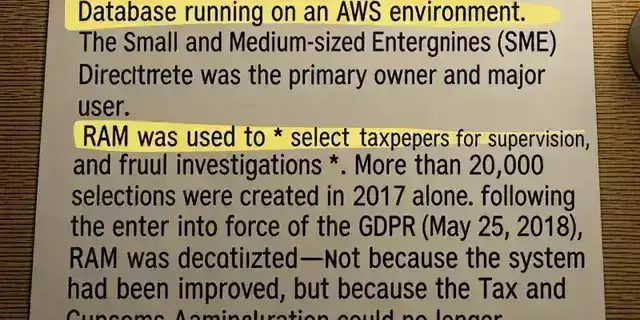
Two internal presentations from the Information Point archive show the FSV as the Belastingdienst itself spoke of it: a system used from …

On 20 May 2019 the Belastingdienst's Directorate of Enforcement Policy conceded in a memo to minister Wiebes and state secretary Snel that …

Beyond the 903 Ombudsman documents, the Childcare Allowance Information Point holds some 6,600 other records: five large release series, Wob …

In January 2014 the project plan Recovery from abroad appeared, followed by an improvement memo and a staff handbook. The documents show an …

The Belastingdienst team EOS ran the tips-and-informants mailbox and fed signals to the RIEC, the regional anti-undermining centres. In 2021 …
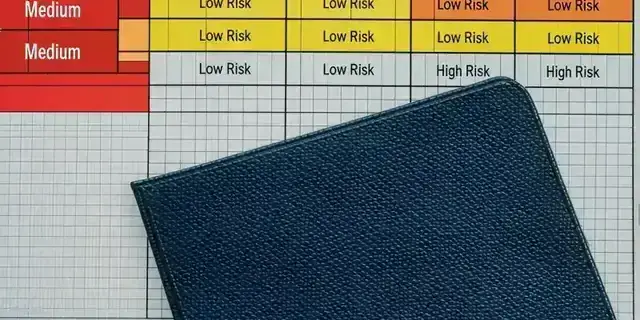
An internal design document of 11 September 2013 describes how the risk selection of Benefits was built around Deloitte's RS risk selection …

The National Ombudsman used an information demand to extract two releases of 903 internal documents from the Belastingdienst, covering 2012 …
The Jetten cabinet refuses to file a criminal complaint against its own officials over the data vault containing 64 million files, while …

The people who controlled the data vault in 2019 and 2020 have almost all left. Whoever is responsible today was mostly not there when the …

The childcare benefits scandal was no incidental bureaucratic cruelty but the visible tip of an algorithmic iceberg. The Tax and Customs …

The Regio Data Model (RDM) was the MKB-specific risk classification layer of the Tax and Customs Administration, built on top of the Risk …

The Tax and Customs Administration's data vault contains at least 64 million files according to the cabinet, possibly 200 to 300 million …

The Dutch state spends roughly six billion euros a year on large ICT projects, of which 27 percent run over budget, a record in 2024. At the …

The ABDTOPConsult essay The influence of New Public Management on the Ministry of SZW, written on commission for the parliamentary inquiry …
Of the 11.7 billion budget, 30% goes to administration, 55% to citizens, and 15% leaks into waste and improper payments. 117,292 child …
The Dutch administrative court has no effective enforcement mechanism against a government that refuses to decide. UHT pays 59 million euros …
The Risk Analysis Model (RAM) was officially deactivated on 18 May 2018, one day before the GDPR took effect. But RAM never disappeared. …

A data vault containing 64 million files, created in 2019, was concealed from parliamentary inquiry committees for years. The timeline …
Belastingdienst surveillance data from RAM and FSV was shared with regional and national crime-fighting centers (RIEC/LIEC) for organized …

From mid-2013, the Belastingdienst/Toeslagen operated Heidi, a logging system that collected portal data from the benefits website including …
The Risk Analysis Model (RAM) was the largest and most invasive surveillance instrument the Dutch Tax and Customs Administration …

The information management of the Tax and Customs Administration/Benefits in the benefits scandal reveals seven systematic violations of the …

WOO-released records (reference 2025-0000536993) of Catshuis meetings and parent conversations from February 2020 through March 2021 reveal …
The confidential PwC working document of 9 February 2022 delivers hard evidence of institutional racism at every level of the Tax and …

The inspection report into the information management of the Tax and Customs Administration/Benefits concludes systematic information chaos …
The benefits scandal hit SME owners and self-employed workers disproportionately hard: more complex finances, their role as childminder …

The discussion paper for the FSV Steering Group of 25 June 2020 shows that the Tax and Customs Administration systematically violated the …
WOO decision 2025-0000536993 (Ministry of Finance, 14 April 2026) released 91 internal documents on the Toeslagen recovery operation, 11 of …

A classified project plan from May 2014 defined 13 sub-projects to combat fictitious employment relationships across Dutch government …
Investigation reveals that entrepreneur damage was never included as a separate category in the toeslagenaffaire compensation framework. All …

Three state-funded organizations deliver compensation to childcare benefits victims, yet victims receive only 15-31% of actual damages on …
The Dutch Tax Authority (Belastingdienst) operates 68 registered algorithms, of which more than 50 have been ruled discriminatory and …
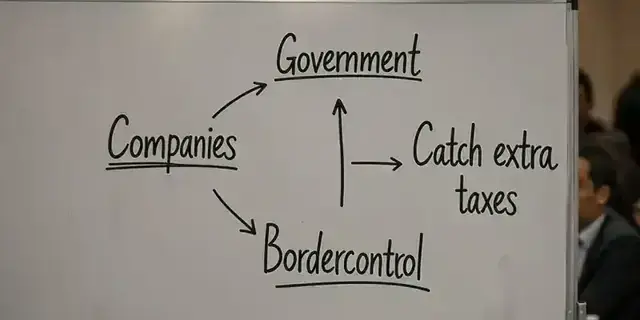
Investigation maps the complete data pipeline from Belastingdienst internal systems (FSV, CAF, OGS) through the Schuldenknooppunt to …
Investigation of Dutch open data portals reveals that Rechtspraak.nl provides a functional REST API for jurisprudence research with …

April 2026 knowledge update covering key literature (Frederik, Raaijmakers), the 64-million-file data vault revelation, the 22nd progress …

The Informatiepunt Kinderopvangtoeslag (IPKOT) is a stagnant document archive last updated December 2023, containing 9,717 documents from …

Research across Tweede Kamer portals, WRR and Open Overheid reveals the most recent parliamentary debate (March 19, 2026) confirmed 69,000+ …

Systematic review of 20+ recognized Dutch legal information sources and 10 additional sources reveals the current state of the …

Thorough analysis of 13 key court rulings in the toeslagenaffaire from the Veenbroei arrest (1988) to the Rechtbank Amsterdam ruling (March …

Three causal chains connect the Belastingdienst's Fraud Signalerings Voorziening (FSV) to the systematic destruction of entrepreneurs. The …
Thorough legal analysis identifying violations across 75+ statutory provisions including the Dutch Constitution, Awb, BW, GDPR, Archives …

A data vault created in May 2019 as a stopgap GDPR measure by the Belastingdienst was rediscovered in April 2026 containing at least 64 …

On April 15, 2026, the cabinet revealed that the Belastingdienst discovered a digital 'data vault' containing at least 64 million files that …
WOO disclosure (ref. 2025-0000536993) reveals structural failures in the childcare benefits recovery operation, including deliberate refusal …

On March 19, 2026, the Commissie Werkelijke Schade (CWS) officially stopped accepting applications, redirecting approximately 7,000 parents …

On 27 February 2026, the Ministry of Finance halted the CWS, the only administrative law route for individual damage assessment, leaving …

The official compensation regime for childcare benefits scandal victims structurally covers only 15-31% of actual damages. Material damage …

No victim has yet filed a pure civil tort claim against the Dutch State for the childcare benefits scandal. All known cases proceed through …

WOO-obtained work instructions for establishing Uncomplicated Debt (OGS) at the Tax Authority reveal a prescribed workflow that …

The childcare benefits recovery operation was designed as an administrative regime that systematically channelled, capped and blocked …

An internal Belastingdienst PowerPoint presentation from July 2016 reveals the full institutional architecture behind the fraud detection …

WRR Working Paper 21, published April 2016, documented the Belastingdienst's data analytics practices, including the BI&A unit processing …
A June 2013 meeting record reveals that Deloitte implemented automated risk classification models for childcare and housing allowances with …